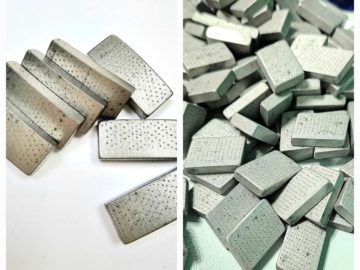
Diamond discs are used for cutting a wide variety of building materials: concrete, stone, asphalt, tiles, bricks and many others. There are a lot of advantages of cutting with a diamond disc, first of all: speed, accuracy, low noise level.
Discs can have different cutting edges: segmented (segments containing industrial diamonds are soldered to the body), turbo edge (corrugated diamond layer) and solid (smooth cutting surface). Each type has its own application features. How to choose the right diamond disc — read on!
Classification of diamond discs
Grinding
They are used for grinding surfaces, removing paint, stripping, etc. They have a bowl-shaped or disc-shaped shape.
Cut-off
They have a flat shape and are used for cutting materials. The working part of the cutting discs can be solid or segmented
Sharpening
They are used for sharpening carbide tools, have a solid working part and a small grain size to obtain a high-quality surface
An important point is that diamond discs are also divided into discs for wet cutting, for dry cutting and universal. Most often, diamond cutting is carried out with water supply (which cools the cutting site), but in some cases it happens that it is not possible or impractical to cut with water supply. Discs that are designed for dry cutting can be used instead of discs for wet cutting, but the latter in no case can be used without cooling. The disc body always indicates what type of cutting it is intended for.
Today, brands such as Messer, Trio Diamond, and Diam are widely known on the market. The range of these manufacturers includes lines of various classes and purposes, which gives wide opportunities for choice. Some equipment manufacturers develop highly specialized discs designed only for their equipment. For example, the Husqvarna Cut-n-Break K760 and K4000 cutters assume the use of only those discs that are designed by the manufacturer specifically for them.